The #MeToo movement was the key trigger, giving rise to fiercely feminist values among young women who felt empowered to speak out against long-running injustices. That spark found especially dry tinder in South Korea, where gender inequality remains stark, and outright misogyny is common.
In the country’s 2022 presidential election, while older men and women voted in lockstep, young men swung heavily behind the right-wing People Power party, and young women backed the liberal Democratic party in almost equal and opposite numbers.
Korea’s is an extreme situation, but it serves as a warning to other countries of what can happen when young men and women part ways. Its society is riven in two. Its marriage rate has plummeted, and birth rate has fallen precipitously, dropping to 0.78 births per woman in 2022, the lowest of any country in the world.
Seven years on from the initial #MeToo explosion, the gender divergence in attitudes has become self-sustaining. Survey data show that in many countries the ideological differences now extend beyond this issue. The clear progressive-vs-conservative divide on sexual harassment appears to have caused — or at least is part of — a broader realignment of young men and women into conservative and liberal camps respectively on other issues.
young women backed the liberal Democratic party in almost equal and opposite numbers
This is only partially true. The key swing vote in the election, that handed Trump the win were; 40+year old white women without a college education. Until this election, that group was almost entirely in the Democrat camp, but went full MAGA.
The youth vote only has a small turnout, with voting patterns locked into geographic regions, there wasn’t too much unexpected that happened with the youth vote.
Be skeptical of recent survey data, reflection on this past election, or any survey data for that matter, especially in a Medium article.
What they are explicitly saying, and not implying at all is, “Korea’s is an extreme situation, but it serves as a warning to other countries of what can happen when young men and women part ways. Its society is riven in two.”
They are not implying the specifics of how the election unfolded in South Korea bears clear resemblance to the US like you stated.
This is a silly discussion because you did read the FT article, speculated wildly, and now are defending your bad take with a vague and baffling two sentence defense. Construct an actual argument.
The article is referring to South Korea, the United States, Germany, and the United Kingdom, 4 countries. I’d argue that the youth vote never really mattered to turn these elections. You have to examine who actually voted, turned out to the ballot box.


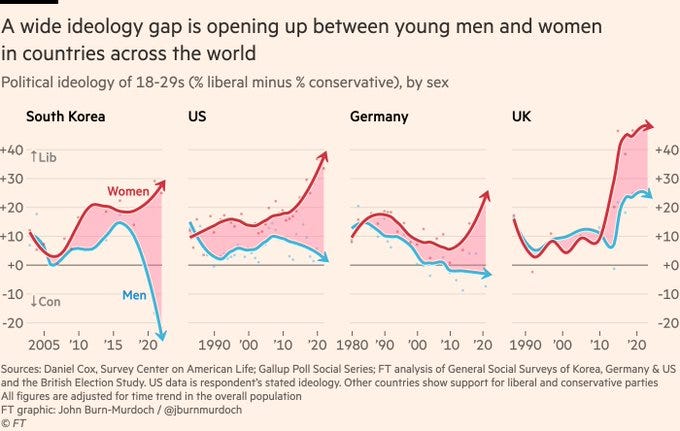
From the article:
So what the article is saying is, saying “sexual harrassment/assault is bad” radicalized all the men?
it’s crazy to me that that was as late as 2018. i definitely felt that circulating in school in 2012.
This is only partially true. The key swing vote in the election, that handed Trump the win were; 40+year old white women without a college education. Until this election, that group was almost entirely in the Democrat camp, but went full MAGA.
The youth vote only has a small turnout, with voting patterns locked into geographic regions, there wasn’t too much unexpected that happened with the youth vote.
Be skeptical of recent survey data, reflection on this past election, or any survey data for that matter, especially in a Medium article.
This quote comes from the graph’s source article from the FT. They are talking about South Korea and not the US.
The author is discussing several countries, including the U.S.A., saying that it is the same trend for each. So yest they are implying the US.
What they are explicitly saying, and not implying at all is, “Korea’s is an extreme situation, but it serves as a warning to other countries of what can happen when young men and women part ways. Its society is riven in two.”
They are not implying the specifics of how the election unfolded in South Korea bears clear resemblance to the US like you stated.
This is a silly discussion because you did read the FT article, speculated wildly, and now are defending your bad take with a vague and baffling two sentence defense. Construct an actual argument.
This makes no sense. Since when do countries other than the US exist?
The article is referring to South Korea, the United States, Germany, and the United Kingdom, 4 countries. I’d argue that the youth vote never really mattered to turn these elections. You have to examine who actually voted, turned out to the ballot box.